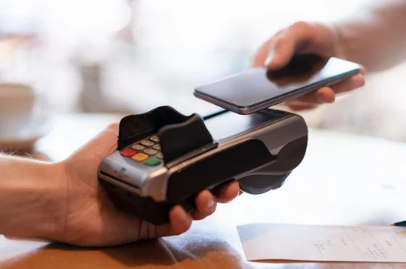
Contactless debit and credit cards are now the norm in the UK. They allow you to pay quickly by tapping your card on a reader, without entering a PIN for most everyday purchases. Roughly three out of every four card payments are now made this way.
Although paying without a PIN can feel risky, contactless fraud makes up only a small share of total card fraud losses. Understanding how the technology works, where it can be used, and what protections exist can help you decide whether it suits you.
How contactless payments work
Contactless cards use near-field communication (NFC) technology. Inside the card is a tiny chip and an antenna that communicate wirelessly with a payment terminal over a very short distance.
To pay, you simply hold your card close to the reader. The terminal sends out a signal, briefly powering the chip in the card. The card and terminal then exchange encrypted information to confirm the payment. If everything checks out, the transaction is approved almost instantly.
You can recognise a contactless card or terminal by the familiar symbol of curved lines, similar to the Wi-Fi icon.
Where contactless payments are accepted
Most UK retailers accept contactless payments, and both major card networks have pushed for near-universal coverage across shops and services.
Public transport has also embraced contactless. In London, you can use contactless cards across buses, the Tube, trams, DLR, Overground services, river buses, and most National Rail routes. Outside London, operators such as Stagecoach accept contactless on buses.
Charities increasingly use “tap-to-donate” terminals, allowing people to make small donations quickly and easily.
Using contactless on Transport for London
On the London transport network, you can travel using:
- an Oyster card,
- a contactless debit or credit card, or
- a mobile payment app.
Oyster cards must be topped up or loaded with passes in advance. Contactless bank cards, by contrast, deduct fares directly from your account on a pay-as-you-go basis. At present, travel passes can’t be added to contactless bank cards.
Daily fare caps apply to both Oyster and contactless journeys. Contactless cards also benefit from weekly caps, calculated from Monday to Sunday, which Oyster cards do not.
If you register your card online with Transport for London, you can report problems, claim refunds for delays, or deal with lost or faulty cards more easily.
Are contactless cards safe?
In general, yes. If your card is lost or stolen and used without your permission, you are entitled to a refund, provided you notify your bank promptly.
Banks also apply additional security measures known as strong customer authentication. These checks require you to use chip-and-PIN after:
- a high-value purchase, or
- a certain amount of cumulative contactless spending.
Historically, UK rules limited individual contactless payments and total spending before a PIN was required. From March 2026, regulators have removed the fixed £100 cap, allowing banks to set their own limits. Many providers are expected to let customers choose their own thresholds or disable contactless entirely if they wish.
Although reported contactless fraud reached a record level in 2023, it still accounted for a small fraction of total card fraud losses.
Mobile wallets and contactless
Digital wallets such as Apple Pay and Google Wallet can be used wherever contactless cards are accepted. They are often considered more secure because:
- retailers never see your actual card number,
- a temporary digital number is used instead, and
- payments require your device to be unlocked.
If your phone is lost or stolen, you can usually disable payments remotely.
Why a contactless payment might be declined
If you reach your cumulative spending limit, the terminal may simply reject the transaction without explanation. Shop staff may assume your card has been declined, even though the issue is just a security check.
In most cases, inserting your card and entering your PIN will resolve the problem immediately. Some banks send app notifications explaining what’s happened, but not all providers do this yet.
Can contactless cards be skimmed?
Industry bodies say there are no confirmed cases of contactless fraud occurring while the card remained in the owner’s possession. In theory, however, it is possible.
Investigations have shown that specialised readers can extract limited card data at very close range. In practice, a criminal would need to be extremely close to you and have access to commercial-grade equipment and accounts. Even when such data is stolen, any resulting fraud is usually recorded as online or “remote” card fraud, rather than contactless fraud.
This means the true scale of contactless-related risks may be difficult to measure precisely.